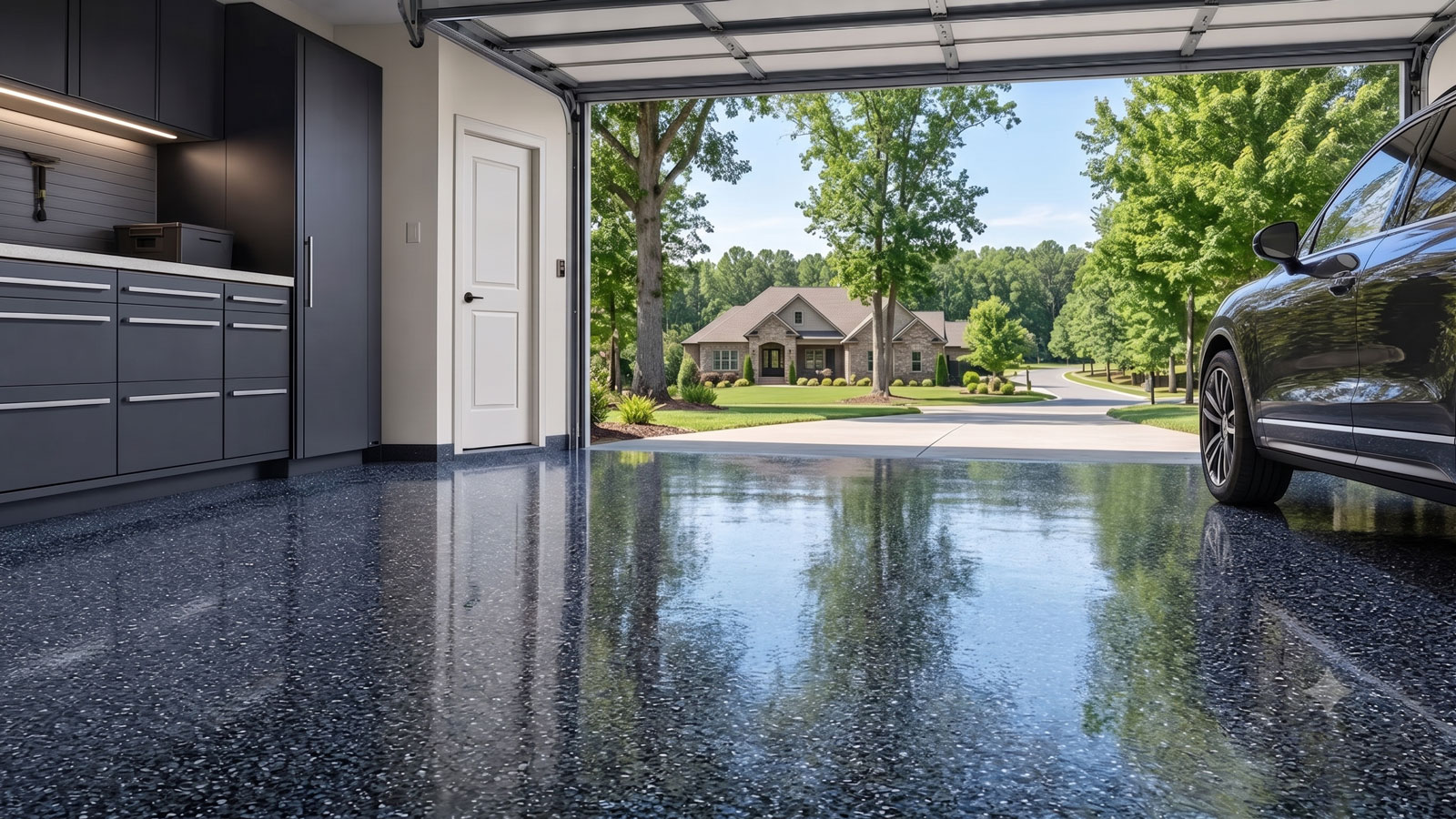
Garage Floor Coating in Myrtle Beach, SC
Floor Coating Services in Myrtle Beach, SC
Myrtle Beach is a coastal city, but most residential garages do not sit in a postcard oceanfront setting. Away from the immediate beach edge, many homes are surrounded by pines, oaks, lawns, and conventional suburban streets. The practical garage-floor issues are usually less about a tropical look and more about humidity, rainwater, tracked sand, strong sun at the door, and what years of use have left on the concrete.
Water movement deserves particular attention here. Myrtle Beach is crossed by several low-lying drainage areas known locally as swashes, and the city continues to invest in watershed and stormwater improvements. A garage does not need to be next to a swash to have a threshold problem; a flat driveway, a low apron, or poorly directed roof and yard drainage can still send water toward the door during heavy rain.
The city also has a substantial homeowner market, with roughly three out of five occupied homes owner-occupied. For a coating project, the useful starting point is the individual property: what is on the slab now, how water behaves at the garage entrance, how much sun reaches the first few feet of floor, and whether sand or wet gear is a routine part of garage use.
Local Market Insight
Myrtle Beach combines a humid coastal climate and flat stormwater-sensitive terrain with many ordinary leafy residential neighborhoods. The best garage-floor plan separates true coastal exposure from the more common questions of slab history, drainage at the threshold, sun, and day-to-day use.
What Affects the Cost of Garage Floor Coating in Myrtle Beach?
Garage floor coating in Myrtle Beach typically runs $6–$12 per square foot, with a typical two-car garage around $3,000–$5,500. Final cost depends on floor size, existing coatings or contamination, crack and patch repair, edge details, drainage-related preparation at the entrance, and the finish system you choose.
Moisture and threshold conditions
Flat coastal terrain can make small grade differences important. If rainwater regularly reaches the garage door, the estimate should separate the coating work from any drainage or threshold problem that needs its own correction.
Old paint, sealer, or previous coating
Many garages have already been painted, sealed, patched, or coated. Weak or unknown material may need to be ground away so the new system bonds to prepared concrete rather than to an older layer.
Sand, road grit, and wet-tire debris
Properties closer to the beach may see more sand, while inland neighborhoods still receive grit and wet-tire debris after storms. Texture should provide useful traction without becoming unnecessarily hard to sweep and wash.
Direct sun at the garage opening
A west- or south-facing door can put strong sun on the first few feet of coating. Sun exposure is most relevant where it actually reaches the floor, so topcoat decisions should follow the garage orientation rather than a blanket coastal assumption.
Cracks, patches, and slab history
Repairs, shrinkage cracks, old patch compounds, and previous remodeling can add preparation. The important question is whether the surrounding concrete and earlier repairs are sound.
Garage use and storage
Beach gear, bicycles, cabinets, freezers, tools, and household storage can reduce working room. Clearing and staging the garage before grinding helps the project proceed continuously.
Call for a clear, project-specific estimate — or request one online.
Local Garage-Floor Conditions in Myrtle Beach
Myrtle Beach's humid climate makes surface condition and moisture history worth checking, but humidity by itself does not mean every slab has a moisture problem. Staining, efflorescence, damp edges, or repeated wetting near the door are more useful clues than the city name alone.
Stormwater is highly local. The city has several named swash watersheds, yet a garage on an ordinary residential street may be affected more by its own driveway pitch, gutters, landscaping, and apron than by a nearby mapped drainage feature. The threshold should be inspected in the context of the whole property.
Coastal exposure also varies sharply. An oceanfront or near-beach garage can see more salt-laden air and sand, while a garage several miles inland may look and behave much like one elsewhere in the Southeast. Preparation and finish choices should match the actual exposure.
Myrtle Beach Stormwater Is a Property-by-Property Issue
Myrtle Beach contains five main swash areas — Bear Branch, Cane Patch, Deep Head, Midway, and Withers — and the city has been evaluating drainage capacity and stormwater needs across multiple watersheds.
For a homeowner, the important lesson is not to assume every garage has a flood problem. It is to look closely at the path water takes during a hard rain: across the driveway, along the curb, from downspouts, and at the garage-door seal.
A floor coating can protect and finish the slab surface, but it should not be sold as a fix for active water entry. Understanding the threshold first prevents a beautiful floor from becoming the place where a drainage problem finally becomes obvious.
Beach-City Address, Mostly Residential Garage Conditions
The oceanfront is only one part of Myrtle Beach. Many residential streets are shaded by mature trees and have conventional lawns, driveways, and attached garages rather than a palm-lined beachfront setting.
That means the useful coating questions are familiar ones: Is the slab sound? Is there old paint or sealer? Where does water go? How much direct sun reaches the door line? What gets stored or tracked into the garage?
Those details produce a more accurate project plan than treating every Myrtle Beach garage as if it sits directly on the sand.
Questions to Answer Before Coating a Myrtle Beach Garage
- Does rainwater ever reach or cross the garage-door threshold?
- Is the slab bare concrete, painted, sealed, or previously coated?
- Are there damp edges, efflorescence, or areas that stay wet after storms?
- How much direct sun reaches the floor when the garage door is open?
- Is sand or wet beach gear a normal use condition, or is the garage primarily an inland suburban space?
- What cracks, patches, storage, or fixed cabinets need to be accounted for before grinding?
Myrtle Beach Garage Floor Coating FAQs
Does every Myrtle Beach garage need a special coastal coating system?
No. Coastal exposure varies greatly across the city. The slab condition, sun, moisture history, garage use, and how close the property is to regular salt and sand exposure matter more than the mailing address alone.
Can garage floor coating stop rainwater from entering the garage?
No. A coating can protect the concrete surface, but active drainage or threshold problems should be identified separately. Driveway pitch, downspouts, swales, and door seals may all matter.
Is extra traction useful in Myrtle Beach?
It can be, especially where wet tires, rainwater, or beach gear are common. The goal is enough texture for the way the garage is used without making the floor unnecessarily difficult to sweep or wash.
Does humidity prevent a durable coating from being installed?
Not by itself. The concrete should be evaluated for actual moisture-related signs and prepared correctly. A humid climate makes inspection important, but it does not automatically disqualify a sound slab.
Myrtle Beach Neighborhoods & Local Context
Phone Quote Line
Speak with a floor coating specialist about your project and get a realistic estimate range.
(843) 966-9906Typical Project Cost
$3,000–$5,500
Typical range for a two-car garage. Final pricing depends on floor size, concrete condition, prep work, coating type, and finish options.
Helpful Guides